
A new study from the research lab of Associate Professor Mary Beth Brown, PT, PhD, found that a remotely monitored, home-based pulmonary rehabilitation program may help people with idiopathic pulmonary fibrosis stay more active and maintain quality of life.
The study, published in Archives of Physical Medicine and Rehabilitation, is the first randomized controlled trial to evaluate a completely home-based pulmonary rehabilitation program for people with idiopathic pulmonary fibrosis, or IPF.
IPF is a progressive lung disease that causes permanent scarring of lung tissue. Although new medications have improved outcomes, many people with the disease continue to struggle to maintain adequate oxygen levels during exertion, and experience reduced exercise tolerance, lower physical activity levels, and diminished quality of life. Traditional pulmonary rehabilitation programs typically require patients to attend specialized centers, which can create barriers to participation and completion.
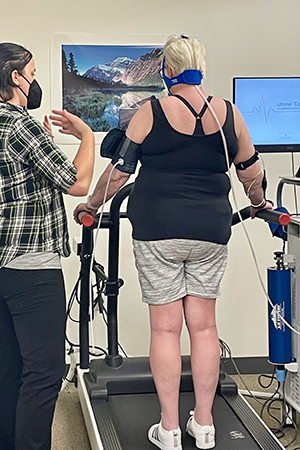
The study tested a 12-week home exercise program supported by wearable devices that allowed researchers to remotely monitor participants' activity levels, heart rate, and oxygen levels. Twenty-nine people with IPF participated in the trial.
Researchers found the program was both feasible and safe. Participants in the exercise group completed the program at a 100 percent rate, adhered to 92 percent of prescribed workouts, and experienced no adverse events.
The most notable finding was a significant increase in moderate-to-vigorous physical activity. Participants using the home-based rehabilitation program increased their activity by an average of 49 minutes per week, a 23 percent increase, while activity levels declined by 35 percent in the control group. The increase was nearly double the published minimal clinically important difference for physical activity in people with IPF, and 70 percent of participants in the exercise group exceeded that threshold.
Participants in the exercise group also improved their distance achieved in a clinical walk test and maintained quality-of-life measures during the study period. The findings suggest that remotely monitored pulmonary rehabilitation may offer a practical alternative for people who face challenges accessing traditional center-based programs, while helping them maintain physical activity and function despite a progressive lung disease.
The study provided research training opportunities for students in the University of Washington’s Department of Rehabilitation Medicine. Doctor of Physical Therapy students and co-authors Emily Borders, DPT; Timothy Gray, DPT; Tor Olson, DPT; Barbara Gordon, DPT; Haotian D. Cai, DPT; and Eliseo Veras-Tobos, DPT assisted with the study as their research capstone in the Brown Lab. Acting Assistant Professor and first author Dr. Claire Child served as study manager while completing her PhD in Rehabilitation Science under the mentorship of Dr. Brown.