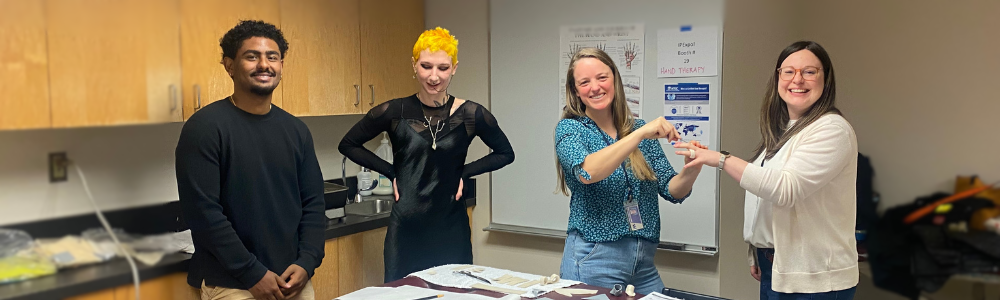
We offer students several unique benefits
- A 4:1 student-to-faculty ratio: Each of the 24 students we admit per year receives personal attention from expert faculty in our in-person program. Our students develop strong camaraderie with their cohort and work together with faculty and staff to sustain a collaborative Community of Learning.
- An interdisciplinary curriculum that emulates real-world occupational therapy practice: Our students have the opportunity to take required and elective coursework with students from other health disciplines.
- Automatic qualification for Educational Staff Associate (ESA) Certification: Our graduates qualify for ESA Certification in the State of Washington so they can take jobs working with children in the public school system with no additional training.
Our graduates are eligible to take the National Board for Certification in Occupational Therapy (NBCOT) exam*. After successful completion of this exam, the individual will be an Occupational Therapist, Registered (OTR). In addition, all states require licensure in order to practice; however, state licenses are usually based on the results of the NBCOT Certification Examination.
*A felony conviction may affect a graduate’s ability to sit for the NBCOT examination or attain state licensure. An individual who is considering entering, or who has already entered, an occupational therapy educational program can have their background reviewed prior to actually applying for the exam by requesting an Early Determination Review. Each early review case is reviewed on an individual basis. After NBCOT has completed its review, the individual is notified in writing regarding whether he/she will be eligible to sit for the NBCOT exam, provided all eligibility requirements are met.
Please read this very important OT admissions update.

The entry-level occupational therapy master’s degree program is accredited by the Accreditation Council for Occupational Therapy Education (ACOTE) of the American Occupational Therapy Association (AOTA), located at 7501 Wisconsin Avenue, Suite 510E Bethesda, MD 20814. ACOTE’s telephone number c/o AOTA is (301) 652-AOTA and its web address is www.acoteonline.org.
Accreditation through this national professional organization ensures that our graduates meet the national standards to become highly skilled occupational therapists. Our program received a 10-year re-accreditation in 2022. Annual written reports for the program are submitted to ACOTE every year. The next full accreditation self-study report and on-site accreditation visit will be held in 2031-32.
The University of Washington Division of Occupational Therapy is currently in Applicant status with ACOTE for an entry-level doctorate (OTD) degree.
| Graduation Year | Students Entering | Students who withdrew or did not graduate with the entering cohort for reasons other than academic performance* | Students graduating within the typical time period of the program | Graduation Rate** |
|---|---|---|---|---|
| 2025 | 24 | 0 | 24 | 100% |
| 2024 | 24 | 7 | 15 | 88% |
| 2023 | 24 | 6 | 18 | 100% |
| 3 Year Total | 72 | 13 | 57 | 97% |
*Students who delayed graduation due to leave related to military, health, family issues, or other reasons not related to academic and clinical performance
**The graduation rate is calculated based on the ACOTE standard (number of students who graduate on time divided by the number of students admitted in the original cohort minus students who encountered military, health, family issues, death and other reasons not related to academic and clinical performance).
See the table below for the NBCOT exam pass rate for the calendar years of 2023- 2025. Certification exam results can also be found on the NBCOT website.
| Calendar Year | Number of graduates who took the NBCOT exam | Number of graduates who passed the NBCOT exam | Percentage of graduates who passed the NBCOT exam |
|---|---|---|---|
| 2025 | 23 | 22 | 96% |
| 2024 | 24 | 24 | 100% |
| 2023 | 23 | 22 | 96% |
| 3 Year Total | 70 | 68 | 97% |
Our faculty are conducting impactful research to promote health and participation across the lifespan for a variety of populations. Our innovative research programs have been funded by the National Institutes of Health, Health Resources and Services Administration, Agency for Healthcare Research and Quality, Substance Abuse and Mental Health Services Administration, National Institute on Disability, Independent Living, and Rehabilitation Research, Patient-Centered Outcomes Research Institute, Centers for Disease Control and Prevention, American Occupational Therapy Foundation, Retirement Research Foundation, and Washington State. We are also training the next generation of rehabilitation researchers through our involvement with the PhD Program in Rehabilitation Sciences.
Tracy Jirikowic’s research focuses on the development of an early intervention model for children with prenatal alcohol exposure and understanding the developmental outcomes of children with fetal alcohol spectrum disorders. She is also interested in community-based interventions that promote social participation, health, and well-being for individuals with intellectual and developmental disabilities. Dr. Jirikowic is a research affiliate with the UW Institute on Human Development and Disability.
Danbi Lee’s research focuses on evaluating ecologically-centered, telehealth self-management interventions to support community transition and participation for individuals who have had a stroke. As an investigator with the UW Center for Health Workforce Studies and co-founder of the Occupational Therapy and Disability Studies Network, she also leads research on addressing disability-related diversity, inclusion, and equity concerns within healthcare and health workforce education.
Donald Fogelberg’s research has primarily focused on the understanding sleep and sleep-related difficulties in clinical populations, with a focus on people who have experienced significant central nervous system dysfunction such as spinal cord injury, traumatic brain injury, multiple sclerosis, and Parkinson Disease. Since 2014, he has contributed his expertise in qualitative research methodologies to an interdisciplinary group that successfully developed a novel prosthetic foot. He is the co-founder of Ellipses, an interdisciplinary special interest group supporting scholars working at the intersection of applied health sciences and the humanities.
Tracy Mroz is a health services researcher and co-director of the Advancing Health Services & Policy In Rehabilitation (ASPIRe) Lab. Her research agenda focuses on the impact of policy and delivery systems on access to and quality of post-acute care. As an investigator with the WWAMI Rural Health Research Center and the UW Center for Health Workforce Studies, she is also leading research on home health care in rural communities and the rehabilitation workforce.
Britt St. John is a translational researcher focused on effectively bridging the gap between research and occupational therapy practice to address critical clinical needs and promote thriving for people with neurodevelopmental disabilities across the lifespan. Her current research is focused on understanding and addressing selective eating in autistic children, theoretical and contextual factors impacting family mealtime, and promoting the health and wellbeing for individuals with intellectual and developmental disability.
Lauren Butler has expertise in emotional regulation, trauma-informed care, and neurodiversity-affirming practices. She is passionate about exploring and implementing new technologies in education. Her current scholarship involves surveying students across the Department of Rehabilitation Medicine programs about their use of Generative Artificial Intelligence tools in academic and clinical settings.
Keri DeGroot is an expert in adult physical rehabilitation, geriatrics, and neurorehabilitation. Her research interests include supporting OT students with disabilities and integration of Artificial Intelligence tools into OT education.
MOT students work on graduate capstone projects during the second year of the program in small groups under the guidance of community mentors and faculty advisors. These projects focus on program development from an OT perspective in collaboration with community settings. They provide an excellent real-world learning experience for students while providing assistance in program development to our community partners.
Project posters from 2025-2026 Academic Year:
- Supporting Engagement in Circus Arts for Children with Physical Disabilities
- Qualitative Program Evaluation for the Adult Neurodevelopmental Wellness Project
- Promoting Wellness and Participation in Older Adults: A Community-Informed Occupational Therapy Workshop Series
- Improving Occupational Engagement in Transitional Housing: An OT Approach to Mental Health Conditions
- First Bite: Evaluating the Acceptability of Caregiver Training Feeding Intervention with Autistic Children
- Staff Training to Support Sensory Needs for Neurodivergent Youth in Mental Health Treatment Settings
From 2022 to 2026, we have had 25 community partners from Seattle, Western Washington, and Portland, Oregon. Many of these sites have partnered with us over multiple years.
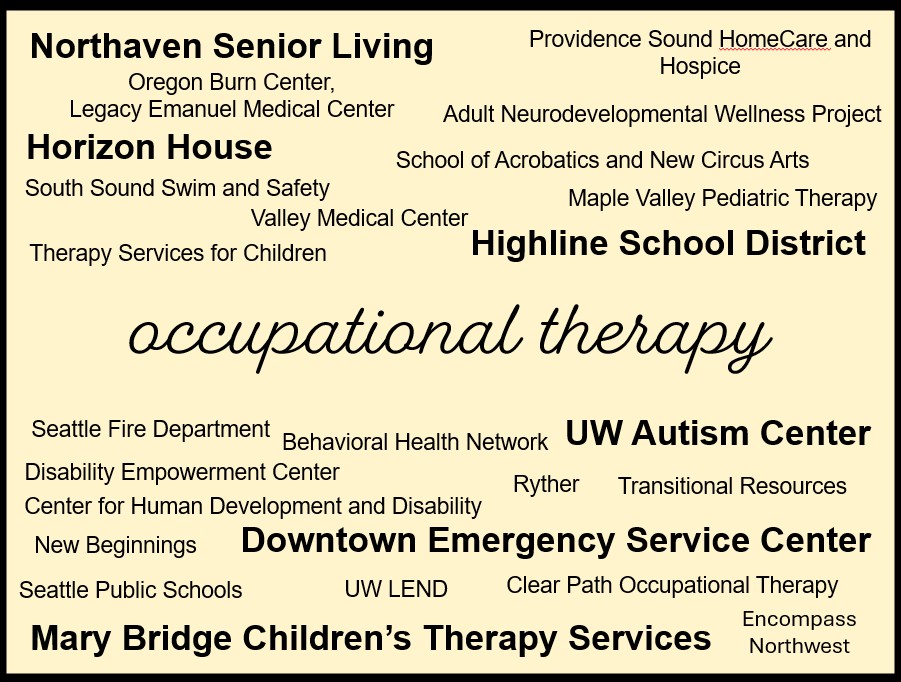
Community Fieldwork Educators offer our students the benefit of their expertise and the opportunity to receive supervised hands-on training. In return, the experience of supervising a future occupational therapist offers Fieldwork Educators access to current practice trends and cutting edge research. Read more about the value and purpose of fieldwork from the American Occupational Therapy Association (AOTA).
Fieldwork I Educator Resources
- Level I Fieldwork (AOTA) describes the experience, offers guidelines, and sample evaluation forms for educators
- UW Level I Fieldwork Sequence and Objectives describes how we prepare our students for their Level I fieldwork experience and outlines the responsibility of the Fieldwork Educators
Fieldwork II Educator Resources
- Level II Fieldwork (AOTA) describes the experience, offers guidelines, sample evaluation forms for educators, and an official position paper
- UW Fieldwork II Roles and Responsibilities describes in detail the responsibilities of the Fieldwork Educator, the Academic Coordinator, and the student
- OTA and OT Aide Supervision Overview
- UW Level II Fieldwork Objectives
The Occupational Therapy Program Advisory Board ensures that our program continues to offer students the most relevant coursework informed by current best practices in occupational therapy. Each member contributes a unique perspective on the evolving trends and challenges in clinical practice. They assess program effectiveness, guide quality improvement, and strengthen ties between our program and the broader occupational therapy community.
- Carlos Alaniz, OTR/L
- Retired
- Heidi Brislin, MS, OTR/L
- Assistive Technology Specialist, Edmonds School District
- Katie Coddington, MOT, OTR/L
- Occupational Therapist, Mary Bridge Children's Hospital
- Vanessa Igelsrud, MOT, OTR/L
- Occupational Therapist, Circle Creek Therapy
- Melissa Porras-Monroe, MA, OTR/L
- Program Director, Occupational Therapy Assistant Program, Green River College
- Teresa Quinlan, COTA/L, CLT
- Occupational Therapist, Providence Home Health, Snohomish County
- Alice Ragan, OTR/L
- Occupational Therapist, University of Washington Medical Center
- Will Shaw, Student
- University of Washington
- Madelaine Stoer, MS, OTR/L
- Inpatient Cancer Care Therapies Supervisor, Occupational Therapist and OT Clinical Fieldwork Coordinator, Seattle Children’s Hospital
- Abigail Tamarack, MS, OTR/L
- Occupational Therapist, Downtown Emergency Services Center
- Lauri Warfield-Larson, OTR/L
- NHA Chief Operating Officer, Horizon House
- Mollie Yates, OTR/L
- Occupational Therapist, Swedish Edmonds
The Janet M. Powell Alumnus/a of the Year Award recognizes outstanding alumni from one or more of the University of Washington Division of Occupational Therapy entry-level and advanced degree programs who have made significant contributions to the field of occupational therapy.
To nominate someone for this award, please fill out this nomination form by Sep 30th. Nominations remain confidential and the recipient is selected by the Advisory Board each year. The recipient speaks (in person or virtually) at the annual symposium and pinning ceremony.

Laura Crooks (BS, 1992)
Laura graduated as a COTA from Green River Community College in 1983, with her OT degree from the University of Washington in 1992, received her MHA from UW in 2012 and her FACHE in 2022. She has authored several articles and a chapter in the textbook Occupational Therapy in Pediatrics. Laura worked for 25 years at Seattle Children’s Hospital overseeing many divisions within the organization before taking the position as CEO at Yakima Children’s Village, a center providing over 30 different subspecialties in central Washington. In 2016, Laura lost her oldest son, Chad, to suicide following a diagnosis of Schizophrenia. She and her husband subsequently founded Chad’s Legacy Project, a non-profit dedicated to stigma reduction, increased access to care and future cures for serious mental illness. Along with the UW Department of Psychiatry, they founded the Washington State Mental Health Summit, creating ripples of change throughout the state and the nation. She serves on several boards throughout Washington and has spoken locally and nationally about her experiences.
Previous Recipients
2025 - Beth Osten
For her dedication to supporting individuals with autism; research and promoting developmental relationship-based services for autistic children and co-authoring the Test of Infant Motor Performance (TIMP).
2024 - Yvonne Swinth
For her accomplishments in academia, promoting the welfare of children in schools and the foster system, and for founding the Journal of Occupational Therapy: Schools and Early Intervention.
2023 - Carlos Alaniz
For his achievements and contributions to advancing OT clinical practice in hospice care and advocacy for OT's role in end of life care.
2022 - Beverly Bell
For her many years of public health service and co-authoring the Klein Bell Activities of Daily Living Scale.
2021 - Todd Lefkowicz
For his international work and service in relation to wheelchair technology access, occupational justice, and for founding Mobility Builders.
2020 Maggie Tai Tucker | 2019 Renee Watling |
2018 Patricia Burtner-Freeman | 2017 Betsy VanLeit |
2016 Jeannette Anderson Murphy | 2015 Rose Racicot |
2014 Roger Ideishi |
|
Each year, we are able to award several partial scholarships to students through the generous gifts made by alumni and friends. These awards are made on a competitive basis.
Elizabeth M. Kanny Endowed Student Support Fund for Occupational Therapy Students
- Congratulations, Lauren Markley Graham, 2026-27 recipient!
Patricia A. Folsom Endowed Fund for Occupational Therapy Students
- Congratulations, Briseida Ayala, 2026-27 recipient!
Fallon Endowed Scholarship Fund
- Congratulations to our four 2026-27 recipients!
- Dana Atienzo Beltran, Anna Bokovoy, Joelle Delettrez, Marley Duncan
Hiranaka Scholar of the Nishimura Hiranaka Endowed Fellowship in Occupational Therapy
- Congratulations, Ada Meyer, 2026-27 recipient!
Teresa Valois Endowed Student Support Fund
- Congratulations, Emma Scanlan, 2026-27 recipient!
Our students have also been recognized by external scholarship programs.
Phyllis Gutiérrez-Kenney Graduate Student Scholars Fellowship
- Congratulations to Briseida Ayala who is a 2026-27 recipient!
UW GSEE Graduate Tuition Awards
- Congratulations to Steady Tran who is a 2026-27 recipient!
Arc of Washington Trust Fund
- Congratulations to Emily Murphy who is a 2026-27 recipient!
We are no longer admitting new MOT students. The information below is intended for current MOT students.
Download this handout for MOT admissions and curriculum details.
To graduate with the MOT degree, students must:
- Earn a minimum grade of 2.7, or a “credit” in non-graded courses, in each required course.
- Maintain a cumulative GPA of 3.0 in all required courses, including didactic and fieldwork courses.
- In any course with both didactic and clinical/laboratory components, pass both portions in order to pass the course.
- Earn “credit” grades in the two required Level II Fieldwork placements.
Autumn 2026 | Academic Year 2026-27 | Total Cost (2.25 years) | |
Resident Tuition & Fees | $6,982 | $27,928 | $62,838 |
Non-Resident Tuition & Fees | $12,149 | $48,596 | $109,341 |
Books (Hardcopies) & Supplies | - | $700 | $1,400 |
Misc. Fees | - | $364 | $613 |
Download this handout for a breakdown of miscellaneous fees. Costs may vary on some items and tuition can change with the start of a new academic year. The majority of UW MOT students fund through a combination of their own resources and student loans. Refer to the Bureau of Labor Statistics for the most recent salary data.
For more information about resources available from the UW and life in the area, visit our life in Seattle page. OT program graduates can explore job opportunities on this website.
UW Disability Resources for Students
UW Programs for OT Students
Professional OT Links
- American Occupational Therapy Association
- American Occupational Therapy Foundation
- AOTA Job Board
- National Board for Certification in Occupational Therapy
- Washington State Occupational Therapy Association