
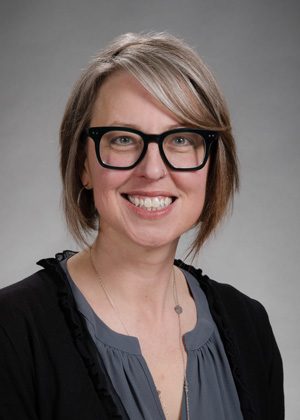
Associate Professor Heather Feldner, PT, PhD, PCS, has received a five-year, $3 million National Institutes of Health (NIH) R01 grant to lead the DRIVE Study (Dynamic, Real-world Learning, Innovative Mobility, and Versatile Exploration).
The multisite study, led by Feldner and co-investigator Dr. Kat Steele, professor of mechanical engineering at the University of Washington, includes collaborators at Oregon State University, Grand Valley State University, and the University of Southern California. The research team will compare an in-home, dose-matched developmental powered mobility intervention with usual care physical therapy for toddlers with cerebral palsy.
The DRIVE Study builds on Dr. Feldner's research focused on early mobility, participation, and family-centered care for children with disabilities. The intervention is designed to support independent exploration and learning by giving young children opportunities to move through and interact with their environments during a critical stage of development.
“Moving yourself through the world, no matter if you walk or wheel, is critical to support brain development and learning. Our past work has shown that if a young child uses a power mobility device, even temporarily while practicing other motor skills, we see benefits in cognition, communication, and motor skill development. Now, we will be able to directly compare the impacts of power mobility intervention versus usual care physical therapy on development and activity in young children who are often denied access to mobility technologies during critical early years of development,” says Dr. Feldner.
Over the next five years, investigators will examine how the interventions affect child development, motor skill acquisition, and parent-reported activity performance and satisfaction. The team will also assess intervention fidelity to ensure consistency across study sites.
The findings could strengthen the evidence base for early powered mobility interventions and help inform rehabilitation practices for young children with cerebral palsy and their families.